Yesterday
32 Pages
One log per book, pages per session
Each book gets its own log, so finishing one does not blend into the next. After a session, enter the pages you read and how long it took. The pages-per-week stat tells you honestly how far you are from the last chapter.
Track how much you read and how fast — book by book.
Also called a book tracker, reading journal or reading diary.
One entry per session, with the timer and location always available. Add or rename variables any time in log settings.
| Variable | Type | Stats shown |
|---|---|---|
| Pages | Number | Sum, Avg per week |
| Timer | Built in | Total time, per entry duration |
| Location | Built in | Pin or place, shown on the log map |
| Notes, photos, sketches, voice memos | Built in | Attached to any entry |
A real screenshot, not a mockup: the stats up top, the streak and the calendar heatmap, with the entries below. Every number comes from the entries you add.
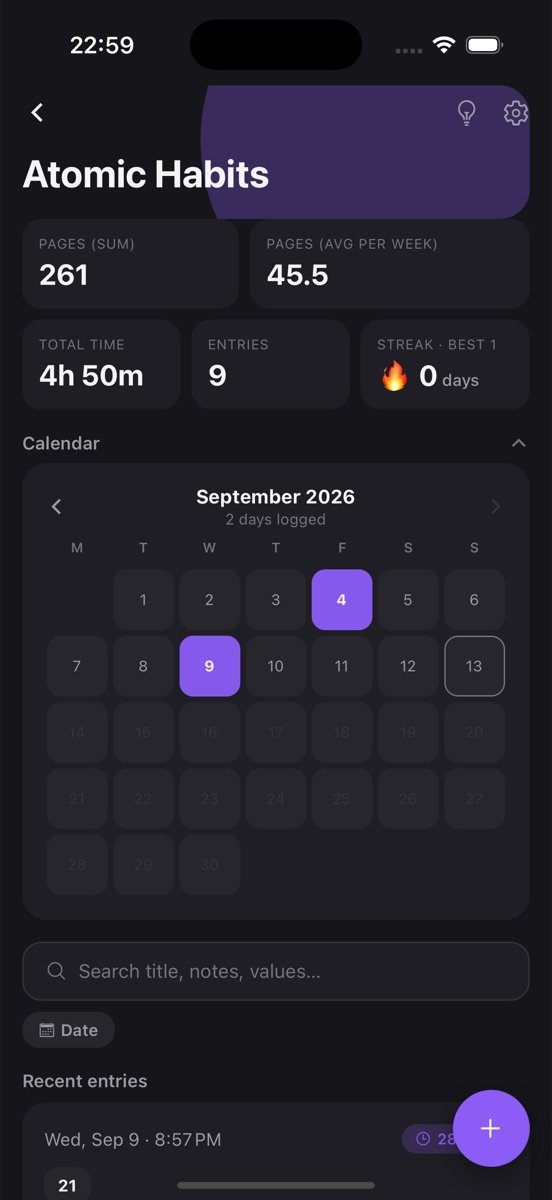
The log is created with the variables above and a few example entries so you can see how it works. Clear them with one tap.
Tap plus, fill in what you have, save. Timer, location, notes and photos are there when you want them, hidden when you don’t.
Sum pages sits on the log card, with the rest one tap away. Set a goal if you want a nudge.
Start the timer when you open the book. Pages per session plus minutes per session gives you a real reading pace.
Tag every book log "books" and filter the overview to see your whole shelf, each with its own progress number.
Jot down a quote or a thought on the entry. Scroll back through a book’s log and you have your own margin notes.
The Atomic Habits log is one log among many you can keep. Every one of them gets the same tools.
Tap the bulb on Atomic Habits and get a plain-language read of your trends, what changed recently, and a suggested next goal, built only from your own entries.
Set a target like three times a week, watch the rolling progress bar, keep a streak, and get a reminder at the time you actually log. The app learns that time from you.
Every log has its own month view showing which days you logged. Gaps are obvious, consistency is visible, and one tap opens that day's entries.
Every exercise in a workout, every piece in a practice session: logged together in one entry, broken out automatically in the stats.
Attach a photo, draw a quick sketch, or record a voice note on any entry. They stay with that entry and come back on every device you sign in on.
Drop a pin or search for the place. Each log has a map view of everywhere you logged, and saved places open directly in Google Maps.
Find an entry by title, note or value across every log, filter by date or location, and jump straight to it.
Entries save on your phone first and sync when you sign in. No account needed to start, no feed, no one else sees your data.
Readers with several books on the go who lose track of pace, students with a reading list and a deadline, and people who want a record of what they read without joining a social network to get it.
Because each book is its own log, it also suits slow readers: a book that takes four months does not get averaged away by one you finished in a weekend.
Pages per session and minutes per session give you a real reading speed, which makes a reading list plannable: a 400-page book at your pace is a known number of evenings. The per-week rate shows whether a busy month actually stopped you reading or just felt like it did.
The notes on each session become the marginalia you never wrote in the book. Scrolling back through them is a fast way to remember what a book was about.
Because each book has its own page count and pace. A single log would average a 900-page novel with a 150-page essay. Tags group them back together on the overview.
Yes. Use minutes instead of pages as the variable, or just rely on the built-in timer and log the chapter as a text variable.
Not yet. The sum of pages is shown; compare it with the book’s length. A "total pages" setting with a percentage is planned.
Free to start. Your logs stay on your phone until you sign in, then they back up and sync.