Yesterday
Push day
3 rounds · Bench Press, Overhead Press, Pull-ups
Every exercise, every session, one entry
One workout is one entry with several rounds: each exercise gets its own reps and weight. The app breaks the numbers out per exercise, so you see your bench press max next to your squat max instead of one meaningless average.
Bench, squat, deadlift — logged as rounds inside a single workout.
Also called a gym log, lifting tracker or strength training journal.
One entry can hold several rounds — each exercise with its own values — and the stats break them out separately.
| Variable | Type | Stats shown |
|---|---|---|
| Exercise | Text · tracked individually | Own stats per value |
| Reps | Number | Sum, Avg per week |
| Weight · kg | Number | Max, Average |
| Timer | Built in | Total time, per entry duration |
| Location | Built in | Pin or place, shown on the log map |
| Notes, photos, sketches, voice memos | Built in | Attached to any entry |
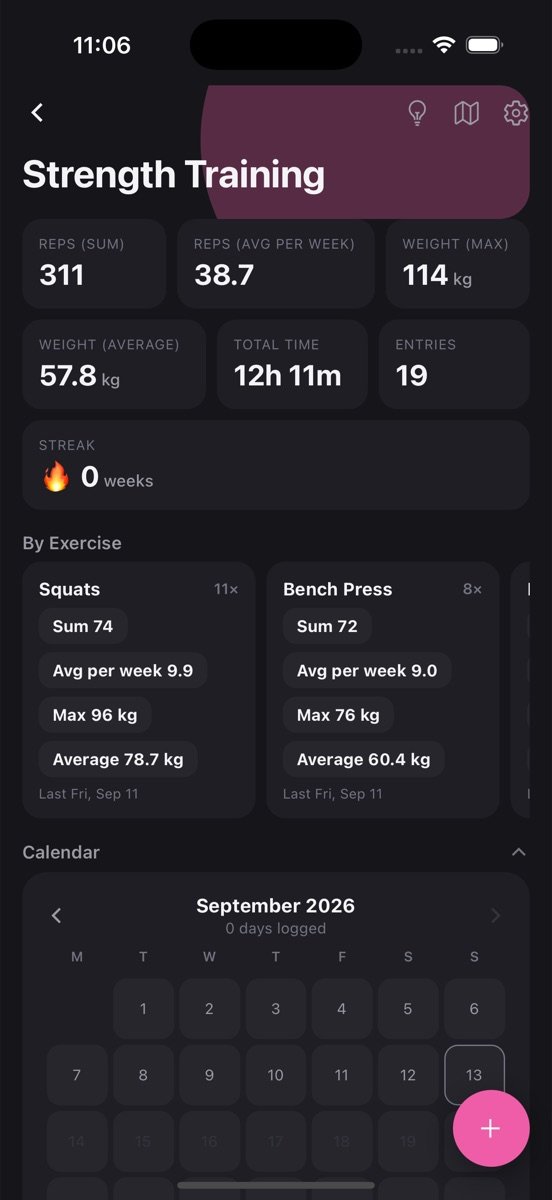
A real screenshot, not a mockup: the stats up top, a breakdown per exercise, the streak and the calendar heatmap, with the entries below. Every number comes from the entries you add.
The log is created with the variables above and a few example entries so you can see how it works. Clear them with one tap.
Tap plus, fill in what you have, save. Timer, location, notes and photos are there when you want them, hidden when you don’t.
Sum reps sits on the log card, with the rest one tap away. Set a goal if you want a nudge.
Mark "Exercise" as tracked individually and the app shows max weight, average reps and last-trained date for each lift separately.
Set "3 sessions a week" and watch the bar fill. The goal is a rolling seven days, so there is no arbitrary Monday reset.
Start the timer when you walk in, tag the gym, and jot down what to change next time. All on the same entry.
The Strength Training log is one log among many you can keep. Every one of them gets the same tools.
Tap the bulb on Strength Training and get a plain-language read of your trends, what changed recently, and a suggested next goal, built only from your own entries.
Set a target like three times a week, watch the rolling progress bar, keep a streak, and get a reminder at the time you actually log. The app learns that time from you.
Every log has its own month view showing which days you logged. Gaps are obvious, consistency is visible, and one tap opens that day's entries.
One entry can hold a round per exercise, each with its own values, and the stats break them out separately.
Attach a photo, draw a quick sketch, or record a voice note on any entry. They stay with that entry and come back on every device you sign in on.
Drop a pin or search for the place. Each log has a map view of everywhere you logged, and saved places open directly in Google Maps.
Find an entry by title, note or value across every log, filter by date or location, and jump straight to it.
Entries save on your phone first and sync when you sign in. No account needed to start, no feed, no one else sees your data.
Lifters who want progression numbers without a spreadsheet, people following a simple program who need to know what they did last time, and anyone who has tried a big fitness app and found it does too much. The log records what you tell it and nothing else.
It works just as well for kettlebells, calisthenics or a home gym, because the exercise names are yours. There is no library to fit into.
The per-exercise breakdown answers the questions that matter: is my bench moving, how long since I last did deadlifts, am I doing more total reps this month than last. The weekly goal shows consistency, which for most people is the real problem, not programming.
Notes on each session turn into a training diary over time. Reading back what felt heavy and what felt easy is often more useful than the numbers.
Streaks reward perfection and punish one missed day. A rate per week rewards showing up. How the rolling goal works and how to set one you will keep.
6 min readWhen to keep one log with a grouping variable, when to split into several, and how tags and rounds fit. Examples for workouts, books, plants and symptoms.
Yes. Each round in an entry is one line, so log "Bench Press, 8 reps, 70 kg" three times for three sets. Total reps and max weight still work per exercise.
No. You type the exercise name and the app remembers it for next time. That keeps the log flexible for kettlebells, calisthenics or anything else.
Not yet. Today you get max weight, average and totals. If you want a calculated 1RM, add a number variable and enter it yourself for now.
Free to start. Your logs stay on your phone until you sign in, then they back up and sync.